
 By Eric Smith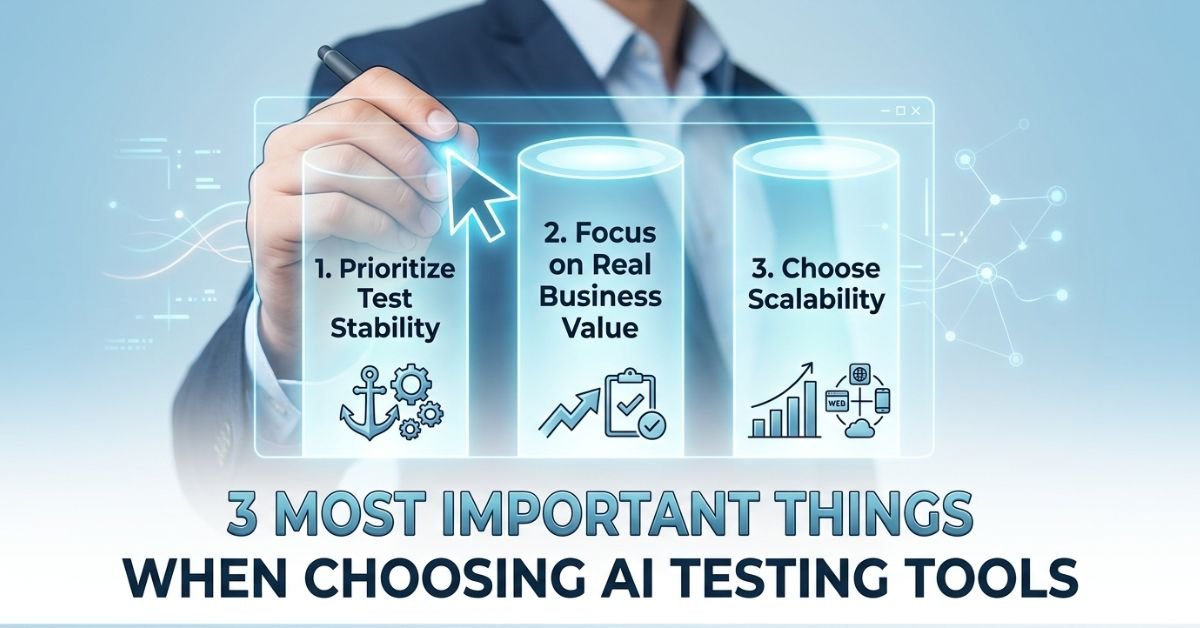
When Michael bought his townhouse in Brooklyn, New York, he expected homeownership to come with surprises. A leaking faucet, a noisy air conditioner, and the occasional electrical issue were all part of the experience. What he did not expect was how much those small problems would teach him about his job.
Michael worked as a QA engineer for a growing software company. During the day, he spent hours testing applications before customers used them. At home, he found himself testing things too. He checked whether a repair really solved the problem. He verified that replacing one part did not create another issue. He learned that quick fixes often looked impressive at first but failed a few weeks later.
That same lesson applies to the growing market of AI testing tools.
His company wanted to modernize its testing process. Every vendor promised faster releases, smarter automation, and fewer manual tasks. The demonstrations looked impressive, but Michael knew better than to judge a solution by its first impression.
Just like buying quality materials for a home renovation, choosing the right AI testing platform requires looking beyond the marketing.
Artificial intelligence is changing software testing by helping teams create tests faster, identify failures, analyze results, and reduce repetitive work.
According to GitHub’s 2024 Developer Survey, over 97% of developers reported using AI coding tools either at work or personally, showing how quickly AI has become part of software development workflows.
Testing naturally follows the same trend.
However, not every AI solution delivers the same long-term value. Some save time today while creating maintenance problems tomorrow.
If you are evaluating AI software testing platforms, three factors deserve more attention than everything else.
Creating automated tests has never been easier.
Many AI tools can generate hundreds of test cases within minutes. While that sounds impressive, the bigger question is:
Will those tests still work six months later?
That was exactly what Michael’s team discovered.
Their first AI testing solution generated tests quickly, but every user interface update caused dozens of failures. Engineers spent more time fixing broken tests than building new features.
The lesson became obvious.
The real value of AI is not generating tests.
The real value is keeping tests reliable.
Applications constantly evolve.
Developers rename buttons.
Layouts change.
New features appear every sprint.
An AI testing platform should adapt to these changes instead of requiring constant maintenance.
For example, tools like testRigor focus on human-readable tests that rely less on fragile technical locators, helping reduce maintenance while allowing both technical and non-technical team members to participate in test creation.
- Stable tests reduce maintenance costs.
- Reliable automation builds team confidence.
- Less maintenance means faster releases.
- AI should reduce work, not create new work.
Many vendors advertise AI-powered capabilities.
Auto-generated tests.
Self-healing.
Visual testing.
Natural language.
Predictive analytics.
These features sound exciting, but Michael learned that features alone do not solve business problems.
Instead, ask simple questions.
The best AI testing platforms allow collaboration between:
- QA engineers
- Manual testers
- Developers
- Product managers
- Business analysts
When more people can understand automated tests, software quality improves across the organization.
Good AI testing tools integrate with:
- CI/CD pipelines
- Jira
- GitHub
- Azure DevOps
- Slack
- API testing workflows
Without integrations, teams often create more manual work instead of less.
According to the 2024 State of DevOps Report by Google Cloud, organizations with mature software delivery practices achieve significantly faster delivery performance through automation and integrated workflows.
Before selecting a platform:
- Define your biggest testing challenge.
- Identify who will create tests.
- Calculate maintenance costs, not just licensing costs.
- Verify integration with your development tools.
- Run a real proof of concept using your application.
Michael remembered another lesson from his house.
When replacing the water heater, he could have bought the cheapest model.
Instead, he chose one designed for a growing family.
It cost more initially, but it avoided another replacement a few years later.
Software testing follows the same principle.
Your testing needs today are rarely your testing needs tomorrow.
Many organizations eventually need testing across:
- Web applications
- Mobile apps
- Desktop software
- APIs
- Email workflows
- End-to-end customer journeys
Switching between different testing platforms often increases complexity.
Choosing one platform that supports multiple environments can simplify maintenance.
| Factor | Lower-Quality AI Tool | Mature AI Testing Tool |
| Test creation | Fast | Fast and maintainable |
| Test maintenance | High | Low |
| Collaboration | Developer focused | Cross-functional teams |
| Platform coverage | Limited | Web, mobile, desktop, APIs |
| Long-term value | Decreases over time | Improves with adoption |
The strongest AI testing solutions generally share several characteristics.
Rather than relying only on technical implementation, they understand actions such as:
- Click Login
- Search for a product
- Submit a form
- Verify confirmation message
This makes tests easier to understand.
AI should automatically adapt to reasonable interface changes whenever possible.
False failures waste engineering time.
Reliable AI testing helps teams trust automation instead of constantly investigating unexpected failures.
AI is powerful, but it is not magic.
Teams should understand their limitations.
- AI cannot replace a good testing strategy.
- Business requirements still require human judgment.
- Generated tests still need review.
- Poor application design creates testing challenges regardless of AI.
As software engineering pioneer Martin Fowler has often emphasized, automation improves existing processes, but it does not automatically fix poor ones.
Software craftsmanship expert Martin Fowler famously wrote:
“Any fool can write code that a computer can understand. Good programmers write code that humans can understand.”
Although Fowler was discussing software development, the same principle applies to testing.
The most valuable AI-generated tests are those that people can easily understand, review, and improve.
Today’s market includes many capable platforms, each serving different needs.
Examples include:
- testRigor
- Selenium with AI-assisted workflows
- Robot Framework AI extensions
- Functionize
- ACCELQ
Rather than asking which tool has the most Also Read: https://therealfinancementor.com/building-a-better-future-with-dgh-a-vision-and-reality/
, ask which platform will still support your testing goals two or three years from now.
That perspective often leads to a better decision.
Months after moving into his New York townhouse, Michael realized something interesting.
The repairs that lasted were never the fastest or the cheapest.
They were the ones built with quality materials, careful planning, and long-term thinking.
His company’s testing strategy followed the same path.
Instead of chasing impressive demonstrations, they focused on stability, business value, and scalability. Their automation became more reliable, maintenance decreased, and releases became less stressful.
The lesson applies whether you are repairing a home or selecting among today’s ai testing tools.
The smartest choice is rarely the one that looks the most exciting on day one.
It is the one that continues delivering value long after the initial excitement has faded.
So before choosing your next AI testing platform, ask yourself one simple question: Will this tool still make my team more productive a year from now?