
 By Eric Smith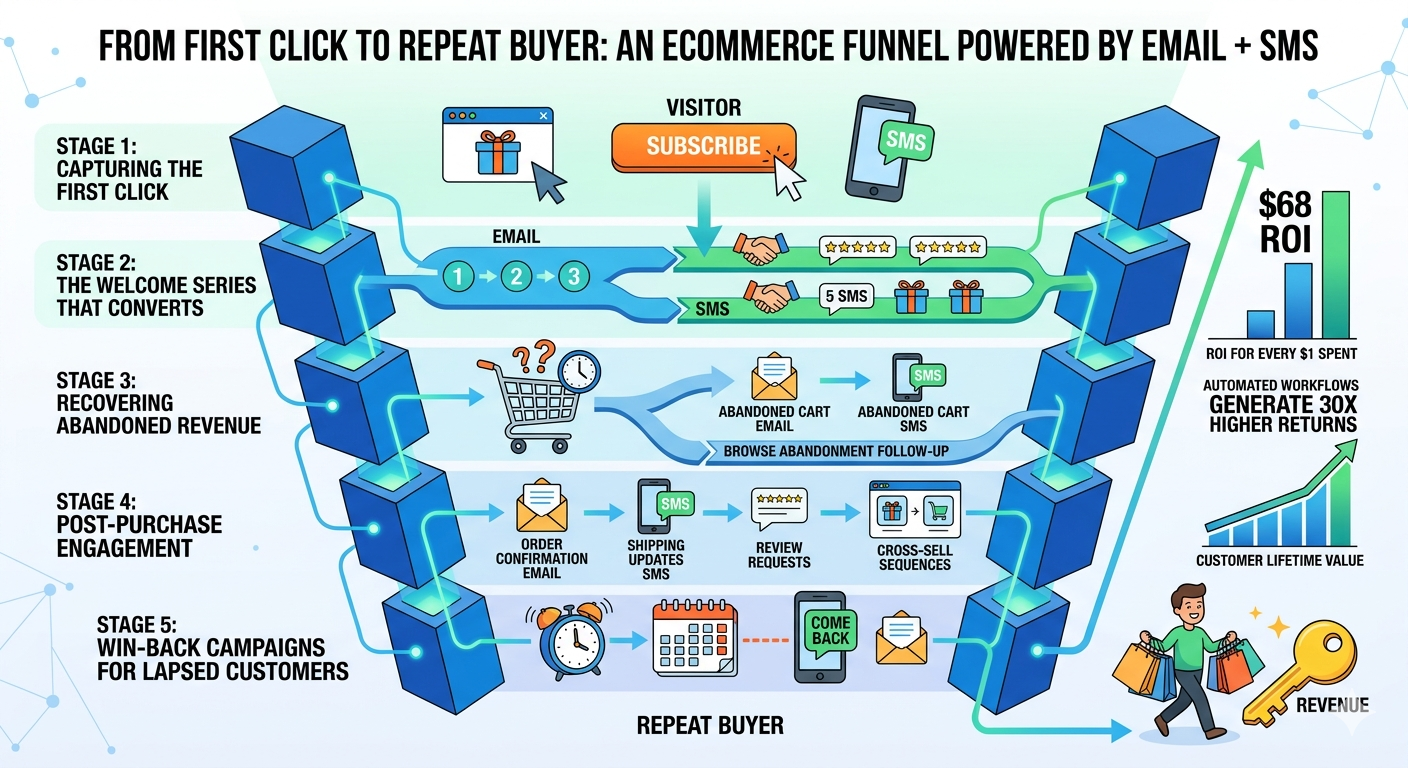
Every ecommerce brand dreams of predictable revenue – sales that roll in without constantly feeding the paid ads machine. The reality? Most store owners are trapped in an expensive cycle: pay for traffic, hope for conversions, repeat.
But here’s what successful ecommerce marketers know: your most profitable customers aren’t coming from your next Facebook campaign. They’re already on your list, waiting for the right message at the right moment.
Building a conversion funnel powered by email and SMS isn’t just a cost-saving strategy – it’s the foundation of sustainable ecommerce growth. Let’s break down exactly how to turn first-time visitors into loyal repeat buyers using owned channels alone.
The economics are compelling. While paid advertising costs continue climbing, email and SMS marketing consistently deliver exceptional ROI. Omnisend customers, for example, see $68 back for every $1 spent – numbers that paid channels simply cannot match.
Beyond the numbers, owned channels offer something invaluable: direct relationships with your customers. You’re not renting attention from platforms that can change algorithms overnight. You’re building an asset that appreciates over time.
Your funnel begins before the purchase – at the moment someone lands on your store. This is where strategic list-building transforms casual browsers into marketing-ready contacts.
Popup forms with purpose: Generic “Subscribe for updates” messaging doesn’t cut it anymore. Instead, offer immediate value – exclusive discounts, early access to new collections, or a compelling lead magnet relevant to your products.
Timing matters: Exit-intent popups capture visitors about to leave. Scroll-triggered forms engage readers who’ve shown genuine interest. Test different triggers to find what resonates with your audience.
SMS opt-in integration: Collecting phone numbers alongside emails doubles your touchpoints. Many shoppers prefer text updates for time-sensitive offers, and SMS open rates consistently exceed 90%.
First impressions shape customer relationships. A strategic welcome sequence does more than say hello – it builds trust, establishes expectations, and drives that crucial first purchase.
Email one (immediate): Deliver the promised incentive and introduce your brand story. Keep it focused – one clear call to action.
Email two (day two): Showcase bestsellers or customer favorites. Social proof works powerfully here – reviews, user-generated content, and testimonials reduce purchase anxiety.
Email three (day four): Address common objections. Shipping policies, return guarantees, and quality commitments remove friction from the buying decision.
SMS touchpoint (day three): A brief, personalized text reminding them about their welcome discount creates urgency without overwhelming.
The key? Automation handles everything. Set it once, and every new subscriber receives a consistent, optimized experience.
Cart abandonment isn’t failure – it’s opportunity. 70.22% of online shopping carts get abandoned, representing massive recoverable revenue.
The three-email recovery sequence:
- Hour one: A gentle reminder with cart contents and a direct checkout link
- Hour 24: Address potential concerns – shipping costs, product questions, or payment security
- Hour 72: Final urgency with a time-limited incentive if margins allow
SMS for immediate impact: A well-timed text message 30 minutes after abandonment can recover sales that email alone might miss. The directness of SMS creates urgency that email cannot replicate.
Browse abandonment deserves attention too. When someone views products without adding to cart, automated follow-ups featuring those items keep your brand top-of-mind.
The sale isn’t the end – it’s the beginning of customer lifetime value. Post-purchase automation transforms one-time buyers into brand advocates.
Order confirmation and shipping updates: These transactional messages have the highest open rates. Use them strategically – include product care tips, styling suggestions, or complementary product recommendations.
Review requests: Timing is everything. Request reviews when customers have had time to experience the product but the purchase remains fresh – typically 7-14 days post-delivery.
Cross-sell sequences: Based on purchase history, recommend products that naturally complement what they’ve bought. Personalized recommendations significantly outperform generic promotions.
Customer acquisition costs 5 to 25 times more than retention costs. Before writing off inactive customers, deploy strategic win-back campaigns.
Segment by engagement level: Someone who hasn’t purchased in 60 days needs different messaging than someone dormant for six months.
Lead with value, not desperation: “We miss you” messaging feels hollow. Instead, highlight what’s new – fresh products, improved services, or exclusive returning-customer offers.
SMS for re-engagement: A direct text message often cuts through inbox clutter better than email for lapsed customers.
Executing this funnel requires tools designed specifically for ecommerce. Generic email platforms lack the deep store integrations – product data, purchase history, browsing behavior – that make personalization possible.
When evaluating platforms, look for:
- Native ecommerce integrations (Shopify, WooCommerce, BigCommerce)
- Combined email and SMS capabilities
- Pre-built automation workflows
- Robust segmentation based on customer behavior
- Clear revenue attribution reporting
Many marketers exploring Brevo alternatives find that purpose-built ecommerce platforms offer features that generic tools simply cannot match – product pickers, order-based triggers, and automated recommendations that drive measurable results.
Track these metrics to optimize your funnel:
- Revenue per email/SMS sent
- Automation revenue vs. campaign revenue
- List growth rate
- Customer lifetime value by acquisition source
- Repeat purchase rate
The goal isn’t vanity metrics like open rates alone – it’s understanding which touchpoints drive actual revenue. Automated workflows generate 30x higher returns compared to one-off campaigns, making automation-focused metrics essential.
You don’t need a perfect funnel on day one. Start with the highest-impact automations: welcome series and cart abandonment. Once those are performing, layer in post-purchase sequences and win-back campaigns.
The beauty of automation? Each workflow you build continues working 24/7, generating revenue while you focus on growing your business.
Your most valuable marketing channel isn’t the next paid platform – it’s the direct line you build with customers who’ve already raised their hand. Start building that relationship today.
 Prime Star