
 By Eric Smith
In today’s world, where the global supply chain is under intense pressure and costs are on the rise, small to medium-sized manufacturers, particularly those in precision-oriented 5 axis industries such as aerospace and medical, are faced with a dilemma. They are required to produce more complex components with higher tolerances, while working under constrained budgets and tight delivery schedules. The problem is not only in making the product but also in the inefficient process of getting there.Traditional multi-step, multi-fixture machining creates a perfect storm of prolonged lead times and cumulative errors from repeated handling, driving up scrap rates and secondary operations that erode profit margins.
This article delves into how 5 axis CNC machining services provide a strategic solution by enabling complete machining in a single setup. It positions this technology not merely as a tool upgrade, but as a holistic lean manufacturing methodology that fundamentally transforms cost structures and operational agility. The following sections will deconstruct how 5-axis technology reshapes manufacturing economics from multiple dimensions.
Traditional Precision Manufacturing Techniques relying on 3-axis or 3+2-axis machining hit significant roadblocks when confronted with parts featuring complex contours, deep cavities, or organic geometries—hallmarks of machining for aerospace structural components and intricate medical device 5-axis machining like orthopedic implants. The fundamental limitation is the need for multiple setups. Each new orientation requires a new fixture, dedicated programming, and manual intervention to reposition and re-zero the part. This multiplies non-cut time, introduces alignment errors at every stage, and increases the risk of human error. The financial toll extends beyond machine hours: it includes the design, fabrication, and storage costs of numerous specialized fixtures, along with the significant coordination and quality inspection overhead for each step.
As noted by the Society of Manufacturing Engineers (SME) , “the reduction of setup times and number of setups is a cornerstone of lean manufacturing,” directly linking process complexity to waste and cost inflation. For the manufacturer, this traditional method makes complex part manufacturing a “black hole” of resource expenditure, where profits are lost in the cycle of handling, inspection, and rework.
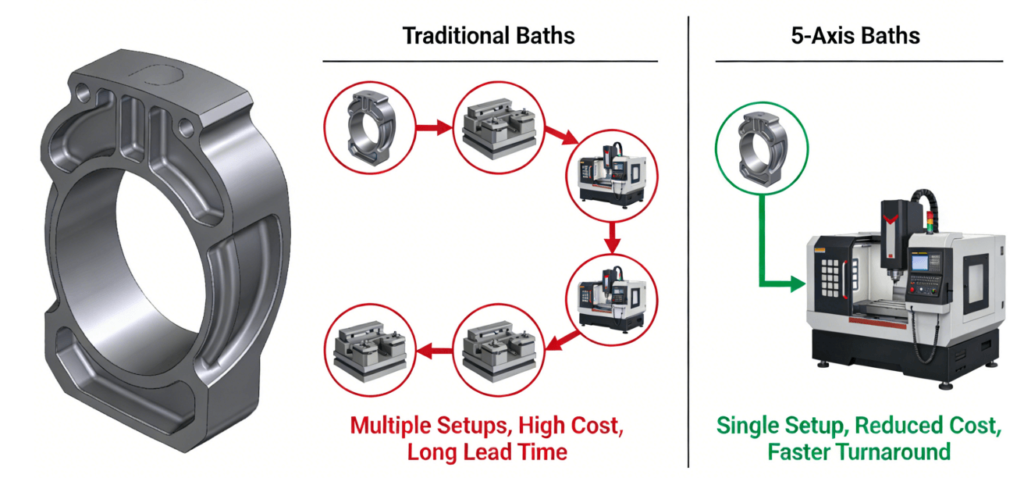
The paradigm shift that 5-axis CNC Machining Services technology provides is the ability to move multiple axes simultaneously. This means that the cutting tool can approach the workpiece from any angle in a single setup.
The most immediate impact is the dramatic reduction in setup time. A part requiring machining on five faces no longer needs five separate fixtures and program runs. This consolidation drastically reduces machine occupancy, manual labor for changeovers, and fixture inventory. For providers and internal shops alike, this translates directly to higher equipment utilization (OEE) and lower overhead cost allocation per part.
This benefit is further amplified when working with difficult materials. In titanium CNC machining, where the material has low thermal conductivity and is strong, it is necessary to ensure that there is continuous engagement and removal of chips. 5-axis machining allows for optimal positioning of the tool, which improves machining conditions. In the case of large and lightweight aluminum parts with complex contours, single-setup machining eliminates the cumulative errors that may result from moving the flexible part from multiple fixtures.
- Eliminating Cumulative Tolerances:
With a single workpiece coordinate system, the dimensional relationship between all features is machined inherently, avoiding the stack-up of tolerances from multiple fixtures. This inherently boosts first-pass yield. - Enhanced Tool Performance:
The tilting flexibility of the tool or the workpiece makes it possible to use shorter cutting tools at optimal angles, which reduces vibrations and thus higher feed rates can be used.”This results in better surface finish qualities and the capability of producing intricate details, thus, usually, there is no need for second finishing operations. “
The advantages of 5-axis integration go well beyond the machining process itself, optimizing the entire product development and manufacturing process. In Rapid Prototyping Solutions, it enables accelerated design verification by enabling engineers to create functional, highly detailed prototypes with complex internal geometries in a single piece, accelerating design cycles. This is essential in applications such as turbine blade 5-axis machining, where complex internal cooling passages and airfoils can be created in a single piece, a challenge that would be virtually impossible to achieve through conventional machining.
Moreover, the same motion enables post-processing automation. With integrated 5 axis industries arm systems, one can program the system to follow the complex surface of a 5-axis machined part for consistent, automated deburring, polishing, or inspection, eliminating variable human labor and ensuring improved finish quality.
Selecting a supplier is more than comparing brands of 5 axis machining center manufacturers. It involves assessing their overall technology and quality infrastructure. First, look for experience in your industry, whether it is aerospace, medical, or automotive, as each has its own set of standards and requirements. Experience should include support for Material Selection Guide, where a supplier with experience can guide you on material properties, machinability, and costs to help you make the best decision for your product. Most importantly, examine their Quality Assurance Standards. Well-defined processes are a must. International recognition such as ISO 9001 (quality management) and AS9100D (aerospace) are good indicators of a supplier’s overall quality infrastructure.
As has been highlighted in NASA technical memorandums on supply chain reliability, supplier certification to high standards is an essential risk management tool, providing traceability for critical components. A supplier such as JS Precision, with a wide range of services such as CNC machining, sheet metal fabrication, and 3D printing, indicates their ability to manage a variety of project requirements within a single quality system.
A precision analytical instrument manufacturer faced a challenge in a critical sensor mounting bracket. The original design involved 12 different aluminum parts that were machined separately, welded, and assembled, which made it vulnerable to alignment problems, high part management, and long lead times.
Through a manufacturability (DFM) analysis with a certified 5-axis machining partner, the bracket design was optimized to a single, monolithic 3-part assembly. The partner’s knowledge of CNC machining and injection molding for similar housings offered cross-process learnings.
- Weight and Performance:
The optimized design cut the overall weight by 15%, improving the instrument’s performance. - Cost and Time:
The total production cost decreased by 28% due to the avoidance of welding, multiple fixtures, and assembly manpower. The lead time from order receipt to shipment was reduced by 50%.
This is a demonstration of the dramatic difference that can be made through informed 5-axis integration. To learn more about how these concepts are implemented in different industries, visit the page for 5 axis industries.
To sum up, 5-axis CNC machining has evolved significantly from a specialized, costly technology of the past to a crucial strategic tool in today’s sophisticated manufacturing environment. It gives a well, defined and quantifiable guide to both cutting costs and enhancing efficiency through process combination, enabling better designs, and automating post, processing.
If your projects are limited by the expense or time delay of complex parts, it is definitely the right time to rethink your manufacturing strategy. Our advice would be to initiate this by a professional manufacturing feasibility study that can highlight the potential value an integrated 5-axis solution could bring to your particular application.
The article has been submitted by an industrial engineer with more than 15 years of experience in precision manufacturing. His area of specialization is the use of advanced machining technology to improve commercial competitiveness.
Q: What are the main sources of cost savings from upgrading from 3-axis to 5-axis CNC machining?
A: The main sources of cost savings are the reduction in fixture costs, disappearance of setup and debugging time, less use of multiple machines, and less scrap/rework due to higher accuracy. Moreover, better overall equipment effectiveness (OEE) over time causes the cost per part to drop.
Q: Is 5- axis machining exclusively for high, production volumes?
A: No way! 5- axis machining can be just as advantageous for low, volume and prototype machining. Rapid prototyping facilitates faster design verification while the single, setup benefit eliminates the necessity for costly dedicated fixture investments for small production runs of complex parts.
Q: How can I find out if my part is a good candidate for 5- axis machining?
A: Mainly if your parts have several surfaces at different angles, complex compound curves, or deep cavities that would mean multiple re, fixturings. If 3- axis machining requires multiple complicated fixtures or angle plates, 5-axis machining would be cheaper.
Q: Is 5- axis programming too complex and expensive?
A: The newest CAM software has significantly made 5- axis programming easier. Although the programming cost will be higher initially, the overall cost of complicated parts can actually go down if you take into account the cost savings of less setups, inspections, and coordination time.
Q: Apart from the machine, what factors do you take into account when assessing a 5- axis service bureau?
A: The experience of the service bureau in your industry, familiarity with materials raised, quality management systems (e.g. proper ISO/industry certifications) and their ability to provide a complete package from design help through to post, processing.
 Prime Star